
21st Century China Center
School of Global Policy and Strategy
UC San Diego
Peer-Reviewed Publications
Disaster Shocks, Anti-Trafficking Laws, and Human Trafficking Networks
Ted Hsuan Yun Chen, Jeffery Shih-Chieh Wang, Ore Koren
International Studies Quarterly 2026 Forthcoming
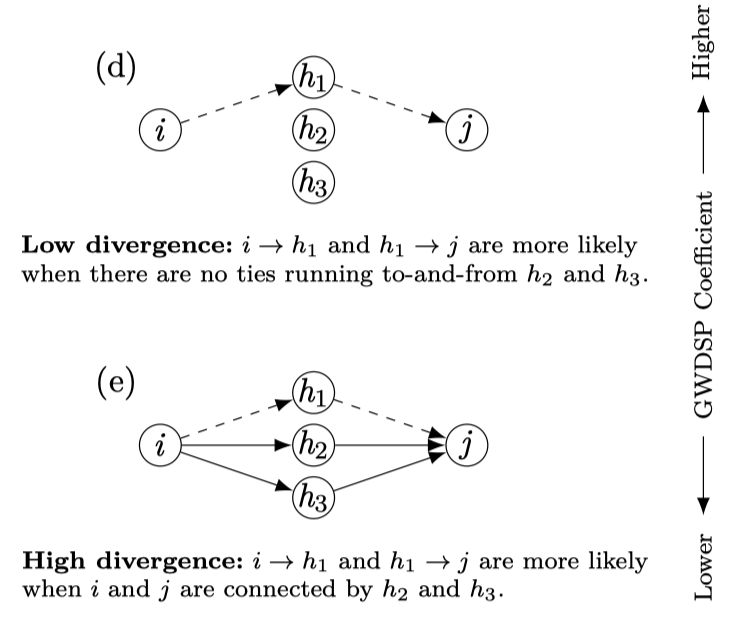
While researchers have shown how anti-trafficking laws and disaster shocks impact human trafficking in origin and destination countries, little attention is given to the intermediary countries through which individuals are trafficked. We develop and test a two-part cost-based explanation of how anti-trafficking laws and disaster shocks impact trafficking networks through intermediary countries. Using inferential network analysis of human trafficking networks mined from the U.S. State Department’s Trafficking in Persons Report, we show that while anti-trafficking laws induce traffickers to diversify their trafficking routes, disaster shocks confound the effect of criminalization by pressuring traffickers to focus their resources on mitigating their impacts.
Disaster Shocks, Anti-Trafficking Laws, and Human Trafficking Networks
Ted Hsuan Yun Chen, Jeffery Shih-Chieh Wang, Ore Koren
International Studies Quarterly 2026 Forthcoming
While researchers have shown how anti-trafficking laws and disaster shocks impact human trafficking in origin and destination countries, little attention is given to the intermediary countries through which individuals are trafficked. We develop and test a two-part cost-based explanation of how anti-trafficking laws and disaster shocks impact trafficking networks through intermediary countries. Using inferential network analysis of human trafficking networks mined from the U.S. State Department’s Trafficking in Persons Report, we show that while anti-trafficking laws induce traffickers to diversify their trafficking routes, disaster shocks confound the effect of criminalization by pressuring traffickers to focus their resources on mitigating their impacts.
Job Market Paper
The Weak Shall Govern? Network Explanations for Non-Binding IGO Effectiveness-Evidence from APEC
Jeffery Shih-Chieh Wang
Job Market PaperUnder Review
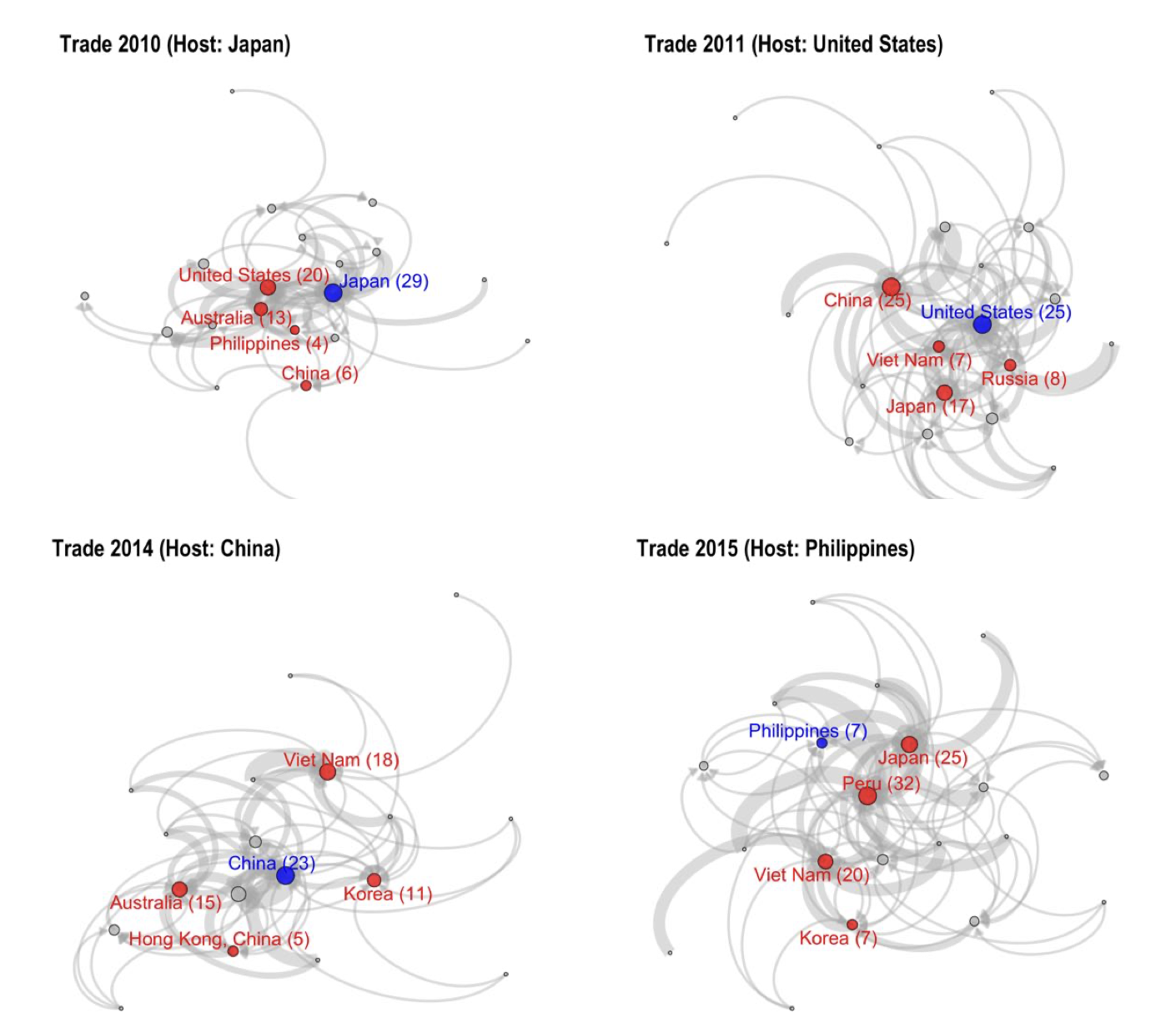
This paper shows that APEC’s effectiveness does not stem from enforcement or formal authority, but from relational, network-driven strategic alignments. Using temporal ERGMs on project co-sponsorship networks, I find that cooperation consistently emerges through brokerage clustering and strategic bandwagoning around influential states. These relational pathways vary across issue domains: high-politics areas exhibit tighter closure shaped by capability and status, while low-politics sectors are more inclusive. Overall, the results suggest that non-binding IGOs endure because they remain attractive to member states by enabling flexible, relational forms of cooperation rather than relying on formal rules or hierarchy.
The Weak Shall Govern? Network Explanations for Non-Binding IGO Effectiveness-Evidence from APEC
Jeffery Shih-Chieh Wang
Job Market PaperUnder Review
This paper shows that APEC’s effectiveness does not stem from enforcement or formal authority, but from relational, network-driven strategic alignments. Using temporal ERGMs on project co-sponsorship networks, I find that cooperation consistently emerges through brokerage clustering and strategic bandwagoning around influential states. These relational pathways vary across issue domains: high-politics areas exhibit tighter closure shaped by capability and status, while low-politics sectors are more inclusive. Overall, the results suggest that non-binding IGOs endure because they remain attractive to member states by enabling flexible, relational forms of cooperation rather than relying on formal rules or hierarchy.
Research in Progress
Technical Cooperation or Hub-and-Spoke? Examining the Strategic Alignment Structure of the ISO Cooperation Network
Jiun-Da Lin, Jeffery Shih-Chieh Wang
Research in Progress
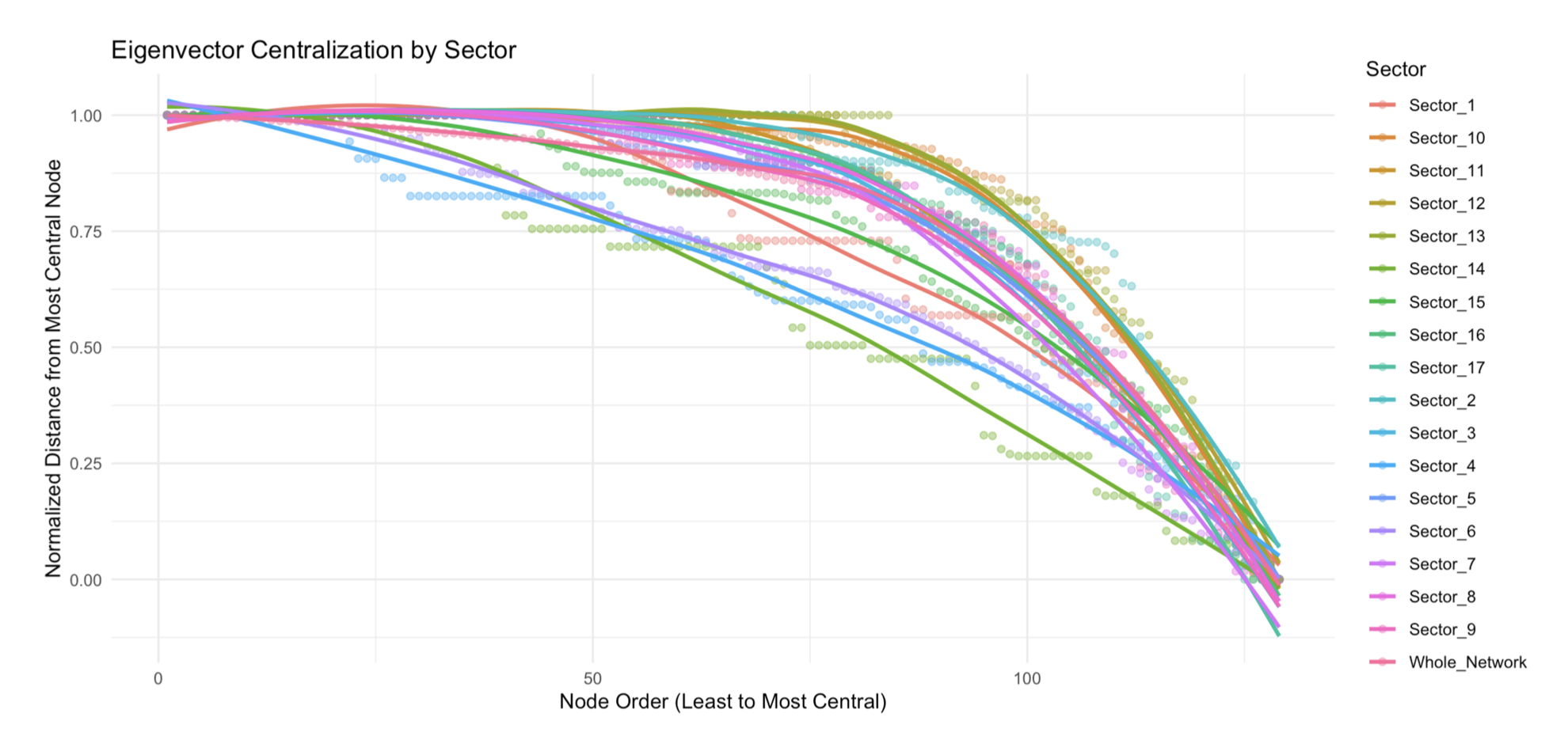
Although the International Organization for Standardization (ISO) is widely seen as a technical forum, we show that its cooperation patterns reflect underlying geopolitical dynamics. Major-power competition shapes participation across ISO Technical Committees, producing uneven alignment and distinct collaboration clusters. A core group—China, Germany, the United Kingdom, France, Japan, the United States, and Russia—drives much of ISO activity. Yet China and the United States rarely lead together, instead heading separate coalitions, revealing the strategic nature of influence in global standard-setting.
Technical Cooperation or Hub-and-Spoke? Examining the Strategic Alignment Structure of the ISO Cooperation Network
Jiun-Da Lin, Jeffery Shih-Chieh Wang
Research in Progress
Although the International Organization for Standardization (ISO) is widely seen as a technical forum, we show that its cooperation patterns reflect underlying geopolitical dynamics. Major-power competition shapes participation across ISO Technical Committees, producing uneven alignment and distinct collaboration clusters. A core group—China, Germany, the United Kingdom, France, Japan, the United States, and Russia—drives much of ISO activity. Yet China and the United States rarely lead together, instead heading separate coalitions, revealing the strategic nature of influence in global standard-setting.
The Robustness of Global Order: Relational Interdependence, Reconfiguration, and Rupture
Jeffery Shih-Chieh Wang
Research in Progress
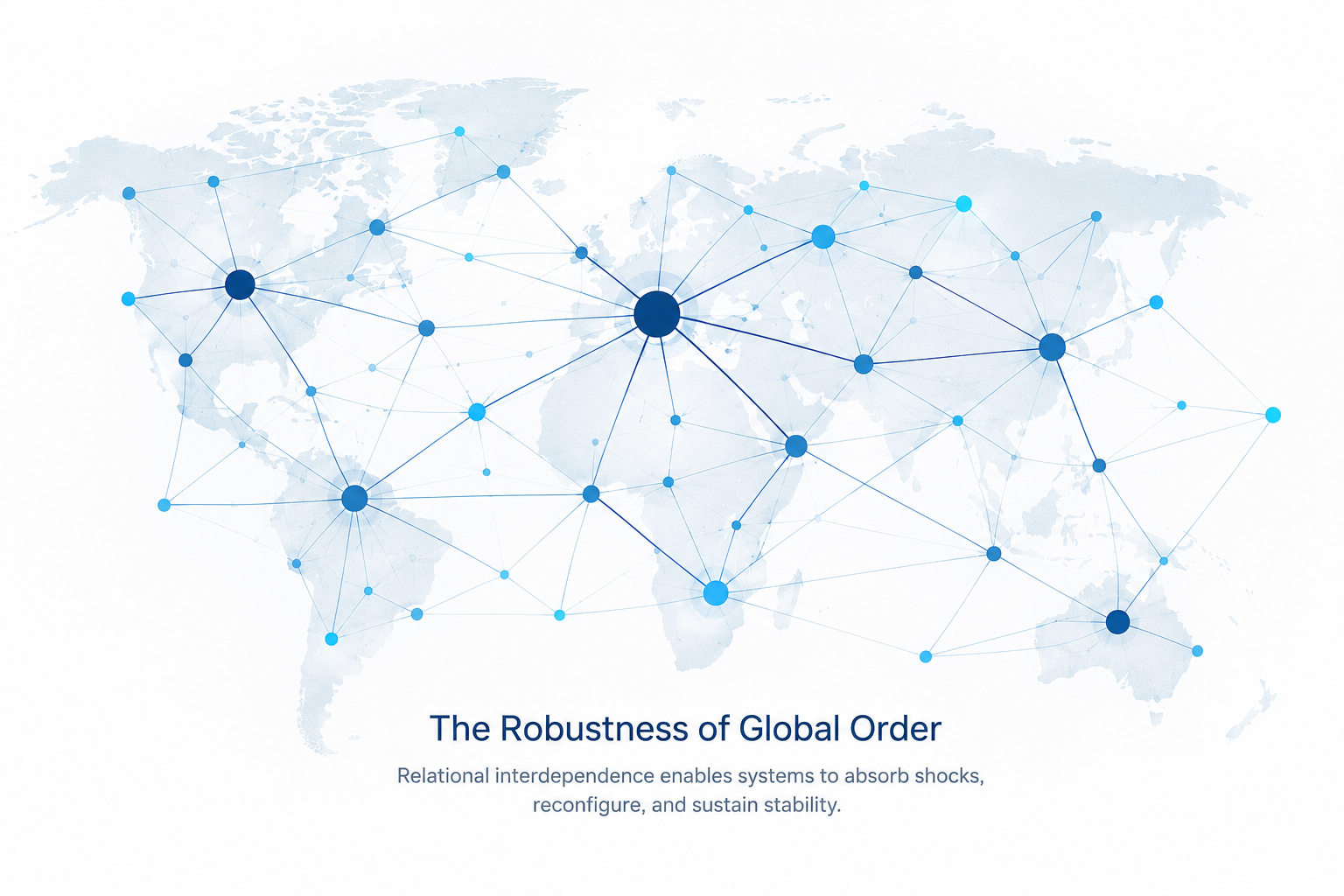
This project constructs temporal network data across alliance, IGO, trade, and financial layers over successive historical periods in order to ask under what conditions cooperation networks fragment, substitute, or reconfigure. The questions are concrete and currently unanswered with relational evidence: when a hub state withdraws, does the network reroute around it or lose a component outright? Do middle powers actually fill the gaps left by great-power retrenchment, or do regional institutions absorb the function instead? Which structural signatures precede fragmentation rather than merely accompany it?
The Robustness of Global Order: Relational Interdependence, Reconfiguration, and Rupture
Jeffery Shih-Chieh Wang
Research in Progress
This project constructs temporal network data across alliance, IGO, trade, and financial layers over successive historical periods in order to ask under what conditions cooperation networks fragment, substitute, or reconfigure. The questions are concrete and currently unanswered with relational evidence: when a hub state withdraws, does the network reroute around it or lose a component outright? Do middle powers actually fill the gaps left by great-power retrenchment, or do regional institutions absorb the function instead? Which structural signatures precede fragmentation rather than merely accompany it?
Policies Diffuse across IGOs: A Multilayer Networks Anlaysis
Jeffery Shih-Chieh Wang
Research in Progress
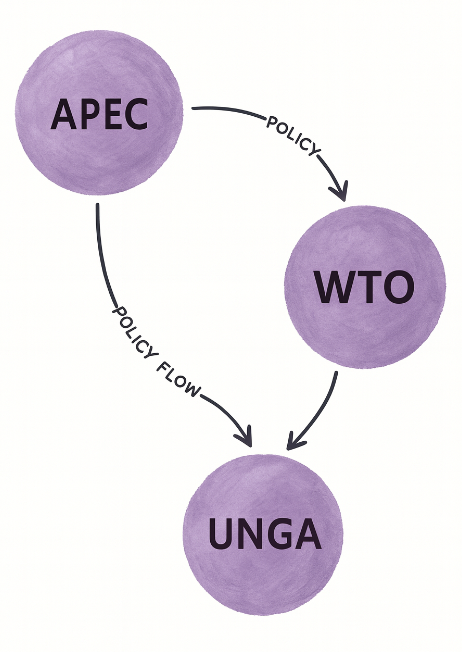
This project examines how policy practices diffuse across international organizations such as APEC, the WTO, and UNGA through multilayer network structures. Treating IGOs as interconnected rather than isolated, it traces cross-institutional policy flows created by overlapping memberships, shared expertise, and repeated interactions. The project identifies mechanisms through which states and institutions leverage participation in one forum to influence others, highlighting how informal venues facilitate policy experimentation that later travels across regimes. The findings illuminate how networked interactions shape regional and global governance beyond formal institutional boundaries.
Policies Diffuse across IGOs: A Multilayer Networks Anlaysis
Jeffery Shih-Chieh Wang
Research in Progress
This project examines how policy practices diffuse across international organizations such as APEC, the WTO, and UNGA through multilayer network structures. Treating IGOs as interconnected rather than isolated, it traces cross-institutional policy flows created by overlapping memberships, shared expertise, and repeated interactions. The project identifies mechanisms through which states and institutions leverage participation in one forum to influence others, highlighting how informal venues facilitate policy experimentation that later travels across regimes. The findings illuminate how networked interactions shape regional and global governance beyond formal institutional boundaries.
Strategic Participation in APEC: A Mechanism-Focused, Process-Tracing Case Study
Jeffery Shih-Chieh Wang
Research in Progress
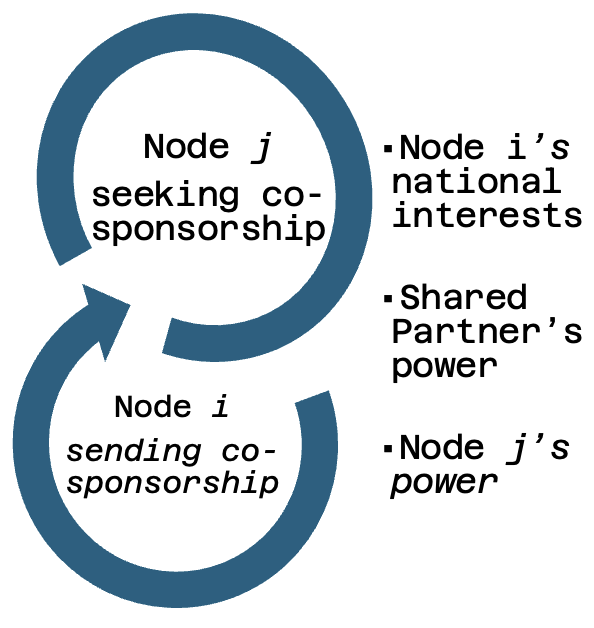
This mechanism-oriented, process-tracing case study examines how APEC member economies strategically engage with and influence policy processes through network interactions. By integrating qualitative process evidence with quantitative network measures, the study aims to reveal the underlying logic of informal cooperation and participation effectiveness.
Strategic Participation in APEC: A Mechanism-Focused, Process-Tracing Case Study
Jeffery Shih-Chieh Wang
Research in Progress
This mechanism-oriented, process-tracing case study examines how APEC member economies strategically engage with and influence policy processes through network interactions. By integrating qualitative process evidence with quantitative network measures, the study aims to reveal the underlying logic of informal cooperation and participation effectiveness.
Modeling IGO Agency through Hypergraph and Bipartite Network Analysis
Jeffery Shih-Chieh Wang
Research in Progress
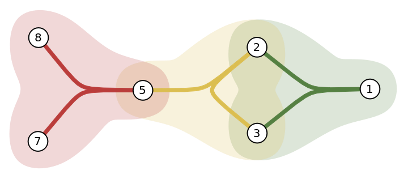
Using advanced network methodologies such as hypergraph and bipartite network analysis, this study conceptualizes international organizations, member states, and issue clusters as interdependent actors. It explores how institutional agency emerges through their co-constitutive interactions, advancing theoretical understanding of power distribution and dynamic governance in global institutions.
Modeling IGO Agency through Hypergraph and Bipartite Network Analysis
Jeffery Shih-Chieh Wang
Research in Progress
Using advanced network methodologies such as hypergraph and bipartite network analysis, this study conceptualizes international organizations, member states, and issue clusters as interdependent actors. It explores how institutional agency emerges through their co-constitutive interactions, advancing theoretical understanding of power distribution and dynamic governance in global institutions.
Data Collection Project: Relational Datasets for Non-binding IGOs
Jeffery Shih-Chieh Wang
Research in Progress
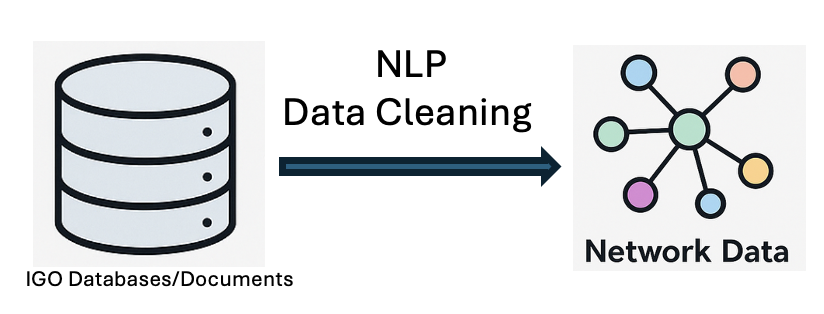
This data collection project aims to collect high-quality network dataset of non-binding intergovernmental organizations to facilitate systematic empirical analysis of institutional linkages. The data infrastructure will be progressively expanded to other types of IGOs, enabling comparative studies of inter-institutional relations and networked governance.
Data Collection Project: Relational Datasets for Non-binding IGOs
Jeffery Shih-Chieh Wang
Research in Progress
This data collection project aims to collect high-quality network dataset of non-binding intergovernmental organizations to facilitate systematic empirical analysis of institutional linkages. The data infrastructure will be progressively expanded to other types of IGOs, enabling comparative studies of inter-institutional relations and networked governance.
Evaluating Taiwan’s Endeavor in APEC under The Political Challenges from China: A Complex Network Perspective
Jeffery Shih-Chieh Wang
Research in Progress
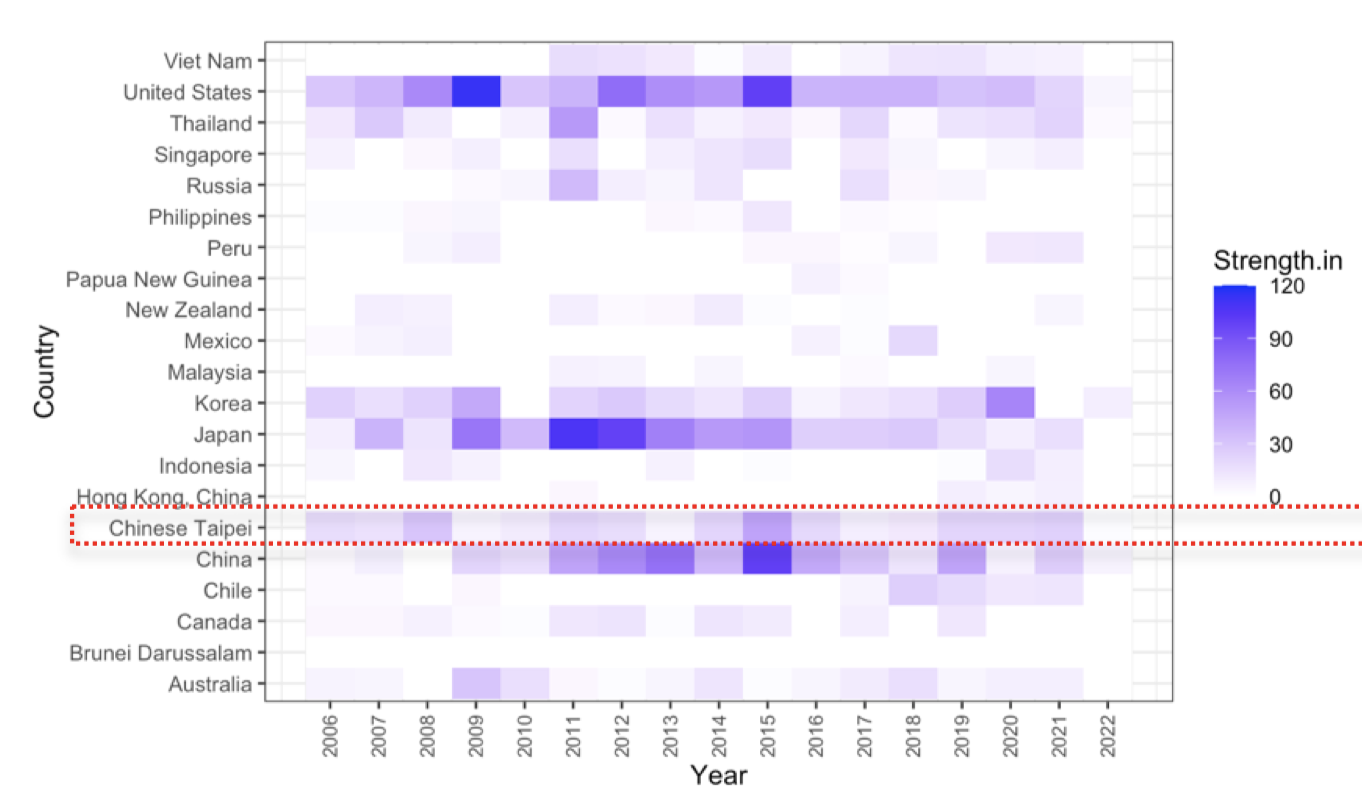
APEC provides a rare institutional platform for Taiwan to engage other economies and shape regional policy agendas, yet the impact of its participation remains understudied. This project examines Taiwan’s role in Science & Technology and Trade cooperation within APEC using network centrality measures and inferential models. The analysis shows that Taiwan occupies a prominent position in Science & Technology networks, receiving extensive co-sponsorship and support from influential partners, while its role in Trade cooperation is more limited, likely reflecting hedging behavior amid U.S.–China competition. The inferential network modeling results identify strategic network effects shaping Taiwan’s positioning and inform policy recommendations to strengthen its engagement across issue areas.
Evaluating Taiwan’s Endeavor in APEC under The Political Challenges from China: A Complex Network Perspective
Jeffery Shih-Chieh Wang
Research in Progress
APEC provides a rare institutional platform for Taiwan to engage other economies and shape regional policy agendas, yet the impact of its participation remains understudied. This project examines Taiwan’s role in Science & Technology and Trade cooperation within APEC using network centrality measures and inferential models. The analysis shows that Taiwan occupies a prominent position in Science & Technology networks, receiving extensive co-sponsorship and support from influential partners, while its role in Trade cooperation is more limited, likely reflecting hedging behavior amid U.S.–China competition. The inferential network modeling results identify strategic network effects shaping Taiwan’s positioning and inform policy recommendations to strengthen its engagement across issue areas.
Books and Policy Papers
Illustrating Political Science (in Chinese)
Lai, Ying-Chie, Tsai-Wei Tseng, Jeffery Shih-Chieh Wang, Yao Hsiao, Wei-Ting Hsu, Chung-You Huang, Pi-Chung Han, Wei-Lun Ko
2016
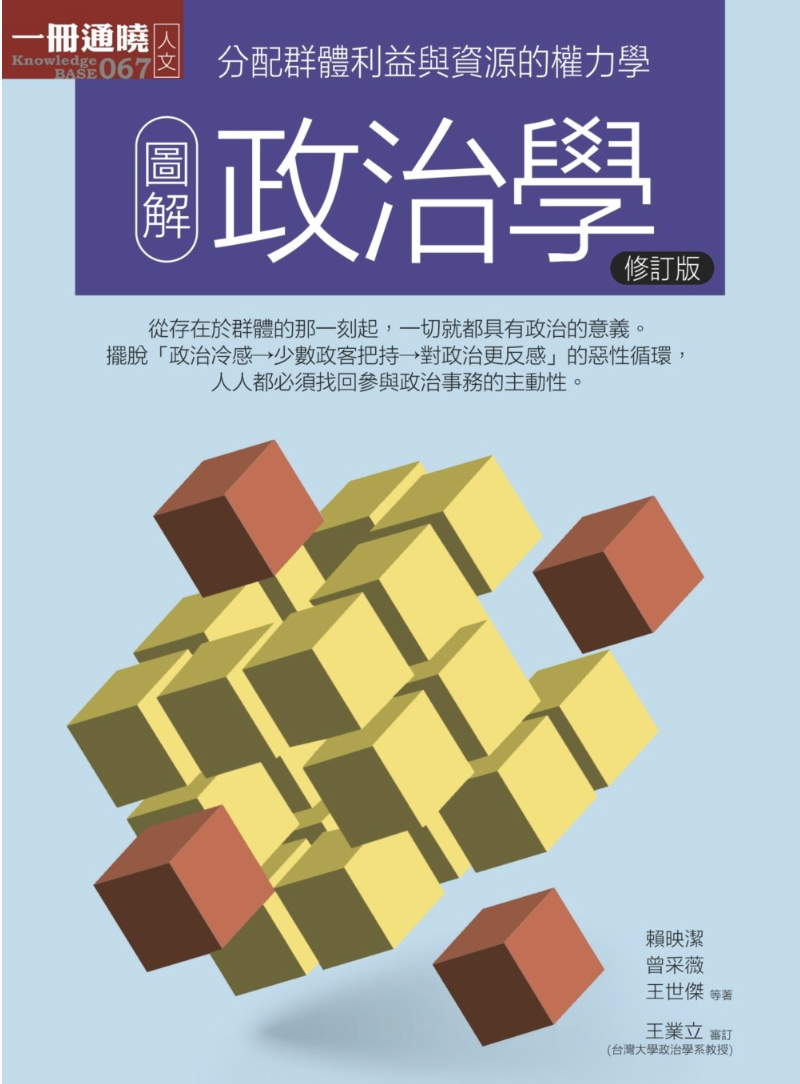
An illustrated introduction to political science. Its eleven chapters cover: the state, ideologies, regime types, parties and interest groups, government structures, public administration, constitutions and courts, elections and participation, political culture, and political change. Each concept is broken down into diagrams for readers with no background in the field, with Taiwanese cases used throughout. I wrote Chapter 4, "Democracy and Dictatorship," covering the definition and preconditions of democracy, varieties of democratic rule, totalitarian and authoritarian regimes, the global trend of democratization, and the process and crises of democratic transition.
Illustrating Political Science (in Chinese)
Lai, Ying-Chie, Tsai-Wei Tseng, Jeffery Shih-Chieh Wang, Yao Hsiao, Wei-Ting Hsu, Chung-You Huang, Pi-Chung Han, Wei-Lun Ko
2016
An illustrated introduction to political science. Its eleven chapters cover: the state, ideologies, regime types, parties and interest groups, government structures, public administration, constitutions and courts, elections and participation, political culture, and political change. Each concept is broken down into diagrams for readers with no background in the field, with Taiwanese cases used throughout. I wrote Chapter 4, "Democracy and Dictatorship," covering the definition and preconditions of democracy, varieties of democratic rule, totalitarian and authoritarian regimes, the global trend of democratization, and the process and crises of democratic transition.
The Perspective and Outlook of Tertiary Education Considering the Development of Taoyuan Aerotropolis Project and Free Economic Pilot Zones Program in Taiwan (in Chinese)
Jeffery Shih-Chieh Wang
Taiwan Economic Research Monthly 2014
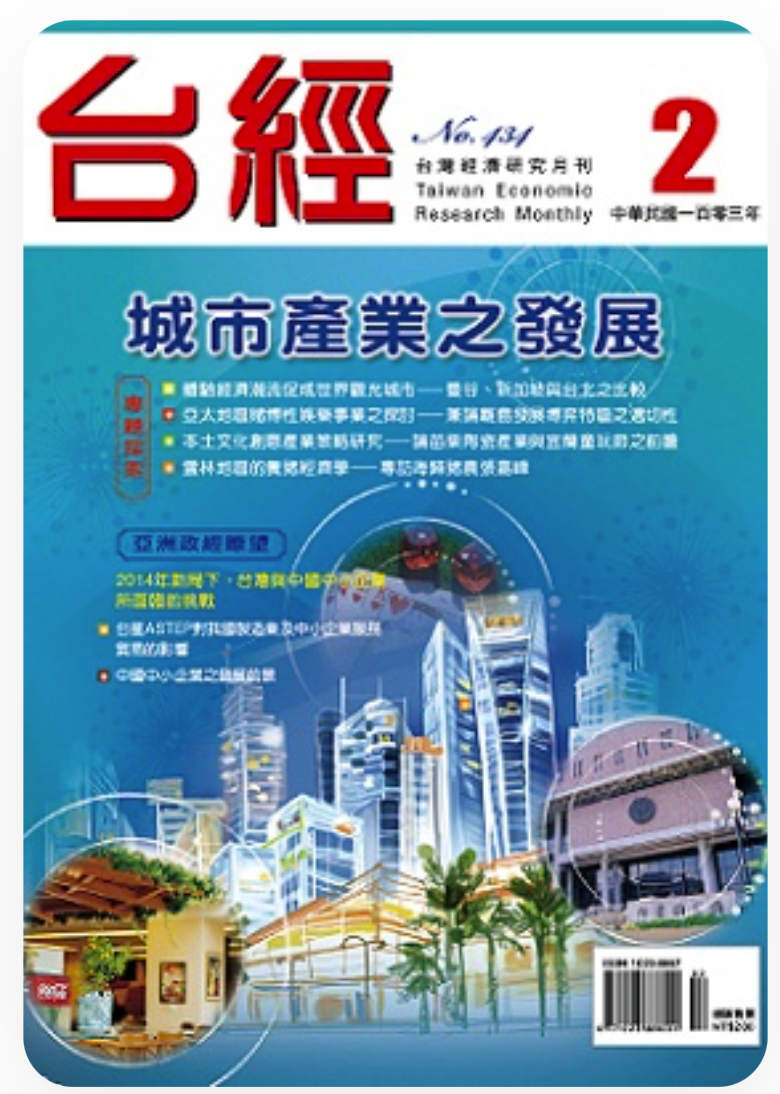
This policy article examines the prospects and challenges facing tertiary education in Taiwan in the context of the Taoyuan Aerotropolis project and the Free Economic Pilot Zones Program.
The Perspective and Outlook of Tertiary Education Considering the Development of Taoyuan Aerotropolis Project and Free Economic Pilot Zones Program in Taiwan (in Chinese)
Jeffery Shih-Chieh Wang
Taiwan Economic Research Monthly 2014
This policy article examines the prospects and challenges facing tertiary education in Taiwan in the context of the Taoyuan Aerotropolis project and the Free Economic Pilot Zones Program.